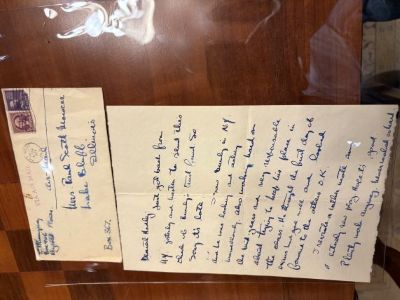
Editor’s Note: The letters described in this series of blog posts were purchased by Taylor Kirkpatrick from a member of the extended Hemingway family. They will appear in future volumes of The Letters of Ernest Hemingway, the comprehensive scholarly edition of Hemingway's letters being published by the Hemingway Letters Project. (The text of the letters themselves cannot be published on the blog at this time because of American copyright law.) Because the letters are privately owned and not yet publicly available for scholars to access at this time, the Society determined that The Hemingway Review blog, rather than the Hemingway Review, is the most appropriate venue for the publication of this information.
Introduction: Provenance and the Significance of the Archive
The recent recovery of a little-known collection of Ernest Hemingway Letters to Hadley Richardson represents a consequential archival development in Hemingway studies in recent years. Comprising twenty-seven letters by Hemingway – twenty-three addressed directly to Hadley, alongside related family correspondence and associated book inscriptions – the collection spans from the early 1920s through the mid-1940s, with its greatest density in the years following the dissolution of the Hemingway–Richardson marriage in January 1927.
The significance of this archive lies not only in its volume but in its position within a long-recognized documentary absence. Hadley Richardson’s acknowledged destruction of approximately two hundred early letters from Hemingway created what Michael Reynolds identified as the largest single gap in the documentary record of Hemingway’s emotional life.1 As a result, scholarly understanding of Hemingway’s first marriage and its aftermath has relied disproportionately upon retrospective accounts, selective reminiscence, and narratives shaped by later marital failures.
The newly uncovered letters inform the gap and reconfigure misperceptions about Hemingway and his relationship with his first wife. Rather than confirming the familiar narrative of emotional abandonment and estrangement, the correspondence reveals a relationship between Ernest and Hadley that deepened in warmth, mutual respect, and ethical collaboration after divorce.
Even more strikingly, the letters provide sustained evidence of Hemingway’s active, reflective fatherhood, offering a portrait that complicates longstanding assumptions about his domestic disengagement outlined in claims from authors such as Kenneth S. Lynn (Hemingway, 1987) and Mary V. Dearborn (Ernest Hemingway: A Biography, 2017) asserting that Hemingway was both self-absorbed and detached from his children. Furthermore, even Hemingway’s own letters to his mother-in-law in 1932 document him claiming that parenting would divert his attention away from writing, going so far as to say that "[t]aking refuge in domestic successes" is "merely a form of quitting."
This archive matters because it revises and reshapes three foundational aspects of Hemingway studies: (1) his emotional continuity with Hadley Richardson after divorce; (2) his identity as a father deeply invested in moral, intellectual, and financial stewardship; and (3) the relationship between these private commitments and the ethical restraint evident in his writing of the 1920s and 1930s.
Taken together, the letters require scholars to reconsider Hemingway not merely as a writer who mythologized masculinity and loss, but as a man who struggled — often thoughtfully and conscientiously — to reconcile intimacy, responsibility, and independence in the wake of marital failure.
Restoring the Hemingway – Hadley Archive
The destruction of Hemingway’s early letters by Hadley Richardson has long shaped critical understanding of their marriage. Carlos Baker, Kenneth Lynn, James R. Mellow, and Mary Dearborn all acknowledge the loss as decisive, noting that it renders Hadley largely voiceless in the documentary record and freezes the marriage at the moment of rupture.2 Bearing in mind Hemingway’s subsequent marriage to Richardson’s friend Pauline Pfeiffer, this disparity has resulted in some writers (Lynn, Dearborn, & Gregory Hemingway, namely) asserting that Hemingway and Richardson’s separation resulted in an aftermath wherein Hemingway maintained his correspondence with Hadley out of necessity rather than continued affection.
Instead, what the present archive restores is not merely correspondence, but relational continuity. The letters demonstrate that Hemingway and Hadley’s relationship did not end with the legal decree of divorce. Instead, it evolved into a collaborative partnership centered on co-parenting, financial responsibility, and mutual regard. Furthermore, the present archive illustrates Hemingway’s desire to present himself favorably with his ex-wife and son in a manner consistent with someone who deeply cares about his relationships with them rather than someone who corresponds solely out of obligation.
The earliest substantive letter in the collection following the divorce, dated January 31, 1938, establishes this tone. Hemingway encloses checks for Bumby’s education fund, outlines new stock allocations, and assures Hadley that he will “look after it right away,” before shifting seamlessly into personal news and affectionate closing remarks.3 The letter is notable not only for its logistical detail but for its presumption of trust: Hemingway treats Hadley as an equal steward of their son’s future, not as a peripheral recipient of obligation.
By 1939, the correspondence adopted a distinctly intimate register. Hemingway begins addressing Hadley by the pet name “Kat” and signing himself “Taty” or variations thereof, names previously associated with the early Paris years of the marriage. In a July 26, 1939 letter, he writes expansively about money, writing, fatigue, and memory, concluding with affectionate reminiscence of shared experiences in Europe.4 Such language suggests not nostalgia but an ongoing emotional bond grounded in shared history and mutual recognition. That is to say, despite their separation, Hemingway’s language towards Richardson does not veer into the realm of absenteeism or sole obligation; instead, their relationship flourishes in a different way, deepening through their written correspondence with one another.
This restoration of intimacy alters aspects of the prior scholarly narrative. Rather than viewing Hadley as a discarded figure eclipsed by Pauline Pfeiffer and later wives, the letters reveal her as a continuing moral and emotional interlocutor in Hemingway’s life well into middle age. This provides nuance to prior understandings of Hemingway as a man constantly in pursuit of change and adventure over stability – rather, it sheds light upon Hemingway as a complex figure motivated by both his love of new experiences in conjunction with the people he loves.
To be continued . . .
Notes
1 Michael Reynolds, The Paris Years of Ernest Hemingway (Oxford: Blackwell, 1989), 34–36.
2 Carlos Baker, Ernest Hemingway: A Life Story (New York: Scribner’s, 1969), 119–21; Kenneth Lynn, Hemingway (New York: Simon & Schuster, 1987), 162–65.
3 Ernest Hemingway to Hadley Richardson, January 31, 1938.
4 Ernest Hemingway to Hadley Richardson, July 26, 1939.